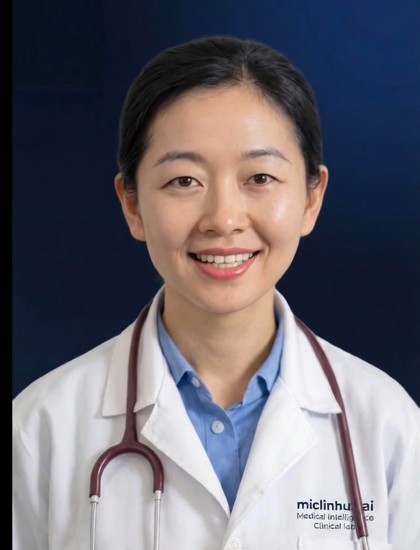
MiClinHub.ai interviews leading clinicians across all medical specialties. Their expertise drives our content and their trust is our most valuable asset.

Dr. Mercè Falip
Neurologist · Epilepsy
Hospital Universitari de Bellvitge · Barcelona, Spain
Dr. Falip is the coordinator of the Epilepsy Unit at Hospital Universitari de Bellvitge, one of Catalonia's leading reference centres for epilepsy surgery. With over two decades of clinical experience, she trained at Vall d'Hebron and Hospital Clínic de Barcelona and has built a multidisciplinary team integrating neurologists and neurosurgeons. Her work spans drug-resistant epilepsy, presurgical evaluation, genetic diagnosis and the clinical application of AI in EEG monitoring.
"Predicting epileptic crises is the holy grail. We are still far away - but AI is beginning to see things we cannot."

Dr. Pablo Iriarte Uribe-Echeverría
Neurologist · AI & Statistics
Osakidetza · Basque Country, Spain
Dr. Iriarte completed his neurology residency at Hospital Universitario de La Princesa (Madrid, 2020-2024), where he specialised in the Epilepsy Unit. He currently works as a Consultant Neurologist at Osakidetza in the Basque Country. Alongside his clinical practice, he served as Professor of Statistics and Epidemiology at AMIR (2023-2025), developing a rare combination of clinical expertise and methodological rigour in machine learning validation. His research interests include AI-assisted EEG analysis, drug-resistant epilepsy and the real-world application of predictive models in neurology.
"The biggest methodological error is assuming that a high internal AUC makes a model directly applicable to clinical practice without external validation."

Dr. Lisardo Ugidos de la Varga
Medical Oncologist · Translational Oncology
Instituto Oncológico Vithas (IOV) · Madrid, Spain
Dr. Ugidos trained at Hospital Ramón y Cajal in Madrid, later specialising in predictive biomarkers and genomic sequencing during a research fellowship in Houston, USA. He now directs clinical research at the VITHAS Oncology Institute and chairs TOMAKAKU, the multidisciplinary head and neck tumour board, where he actively integrates AI into staging, treatment planning and protocol design.
"Clinical judgment still outperforms artificial intelligence today — AI helps, but the decision has to be made by the doctor together with the patient."

Dr. Christos Varounis
Cardiologist · Medical Director, Pharma/MedTech
PhD Cardiology · Biostatistics · Health Economics (LSE) · Greece
Dr. Varounis combines clinical cardiology with a strong background in biostatistics and health economics, having completed his PhD in these fields at the London School of Economics (LSE). He has worked both in clinical practice and in Medical Director roles within the industry, giving him a unique perspective on how to validate and translate AI tools into real value for patients and health systems.
"Data without clinical context is just noise — AI in cardiology only earns its place when it is validated against real-world outcomes."

Dra. Ana Lucrecia Ruiz Echeverría
Head of Melanoma, Head & Neck Cancer and Neuro-Oncology Section
MD Anderson Cancer Center Madrid · Madrid, Spain
Dra. Ruiz Echeverría leads the Melanoma, Head & Neck Cancer and Neuro-Oncology section at MD Anderson Cancer Center Madrid, one of the world's leading oncology reference centres. Her work spans three distinct therapeutic areas, giving her a cross-cutting view of how AI is being integrated into diagnosis and treatment across very different tumour types.
"AI will not replace the tumour board — but it is already changing how we prepare for it, across melanoma, head and neck and neuro-oncology alike."

Dr. Daniel Acosta Eyzaguirre
Medical Oncologist
GenesisCare · Centro 360 de Excelencia Oncológica GCCC · Barcelona, Spain
Dr. Acosta Eyzaguirre is a medical oncologist at GenesisCare and at the Centro 360 de Excelencia Oncológica GCCC in Barcelona, with a particular focus on gastrointestinal oncology and immunotherapy. His day-to-day clinical experience puts him on the front line for assessing the real impact of AI on therapeutic decision-making.
"In gastrointestinal oncology, AI is most useful when it helps us decide faster — not when it tries to decide for us."

Miquel Tarón
Molecular Biologist · Molecular Diagnostics in Lung Cancer
Badalona, Spain
Miquel Tarón is a molecular biologist specialising in molecular diagnostics for lung cancer, based in Badalona. His work focuses on applying AI to NGS panels, liquid biopsy and generative reporting, a key area in precision oncology.
"From NGS panels to liquid biopsy, AI is starting to compress diagnostic timelines that used to take weeks into days."

Dr. Rafael Trujillo Vílchez
Medical Oncologist · Head of Oncology Unit
Hospital Xanit International · Málaga, Spain
Dr. Trujillo Vílchez heads the Oncology Unit at Hospital Xanit International in Málaga, where he combines clinical leadership with a close look at how AI-supported evidence is reshaping everyday oncology practice. His perspective bridges the promise of new AI tools with the discipline of rigorous clinical evidence.
"AI in oncology sits between promise and evidence — our job is to make sure it earns its place through the second, not just the first."

Dr. João Costa Antunes
Cardiology Resident · Specializing in AI
ULSGE (Unidade Local de Saúde Gaia e Espinho) · Portugal
Dr. Costa Antunes is a cardiology resident at ULSGE in Portugal, with a growing focus on how AI tools are being introduced into clinical training and everyday cardiology practice. As a resident, he brings a hands-on, early-career perspective on adopting AI at the bedside, from diagnostics support to workflow integration.
"AI won't replace the reasoning we're taught in residency — but it's already changing how fast we get to the right question."

Global Vice President, Parkinson Franchise
BIAL
Ana Belén Rodríguez Sáiz is Global Vice President of the Parkinson Franchise at BIAL, having previously led its Global Epilepsy Franchise. Her career spans senior global commercial and marketing leadership roles at Novartis, AbbVie, Eli Lilly and Almirall, driving oncology, dermatology and neurology brand strategy across international markets.

Juan Luis Chico García
Neurologist
Hospital Ramón y Cajal · Madrid, Spain
Dr. Chico García is a neurologist at Hospital Ramón y Cajal and co-founder and Chief Scientific Officer (CSO) of Mautilus eHealth SL. His work bridges clinical neurology and digital health innovation, bringing a founder's perspective on how AI-driven tools can be developed and validated for real-world neurological practice.

Nephrology Consultant · MD, PhD
Hospital Universitari Germans Trias i Pujol · Badalona, Spain
Dr. Juega Mariño is a Nephrology Consultant at Hospital Universitari Germans Trias i Pujol and Associate Professor at the Universitat Autònoma de Barcelona (UAB), with clinical expertise in transplantation and interventional nephrology. His work focuses on applying AI, Big Data and innovation to improve patient care, bringing a data-driven perspective to how new technologies can be translated into everyday nephrology practice.